Tax is one of the largest expenses most people face each year, yet it is also one of the areas where ordinary individuals can still take meaningful action. Understanding the rules, using available allowances and reliefs correctly, and organising your affairs in good time can reduce the amount you pay and lower the stress of filing.
This guide is written for people in the United States and the United Kingdom who want clear, realistic advice on tax saving and tax filing in 2026. It covers the main principles, common opportunities, important deadlines, record-keeping, and practical steps you can take. It is not personalised tax advice. Tax rules are detailed and your individual situation may differ, so always check official sources or consult a qualified professional when needed.
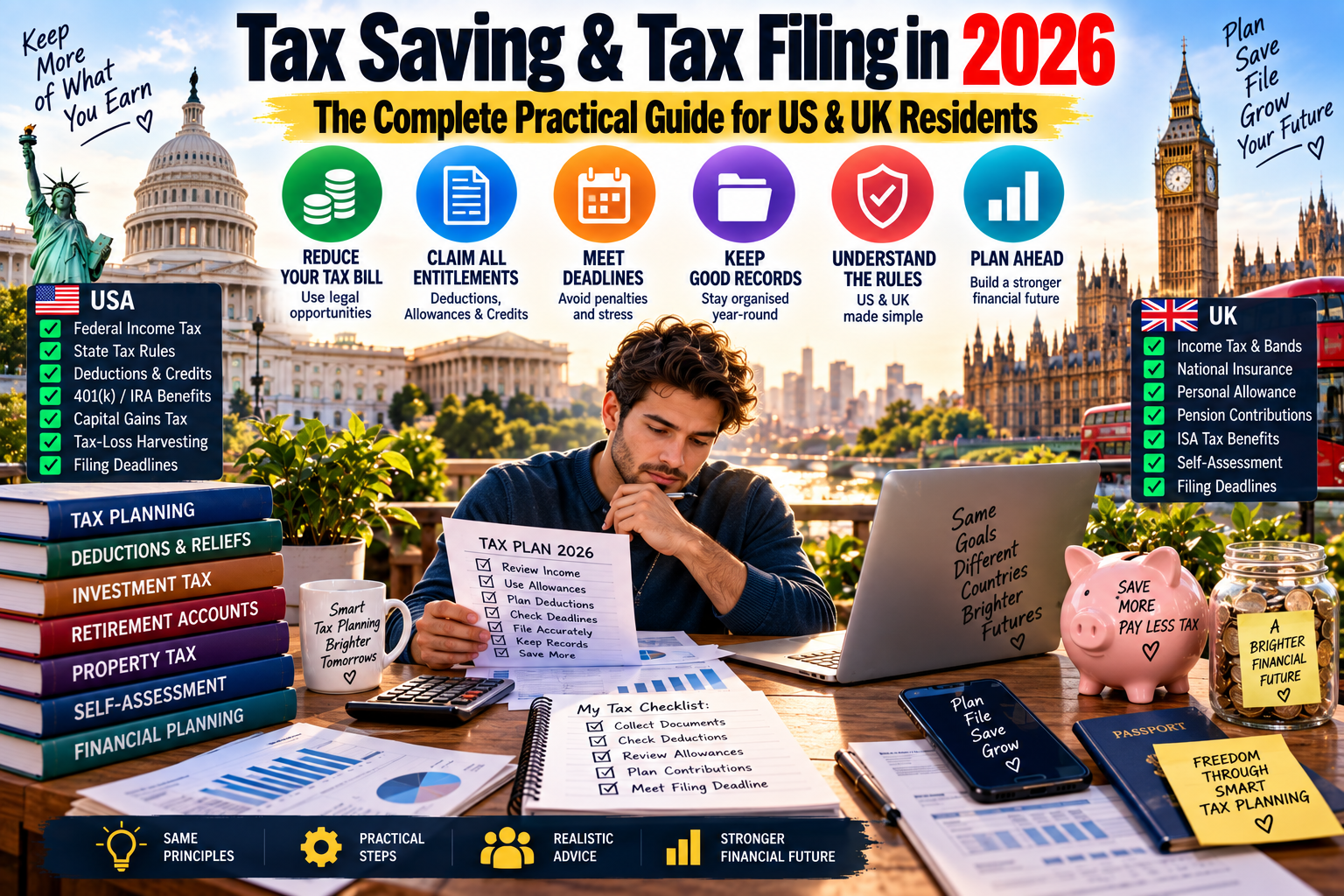
Why Tax Planning Matters
Most people focus on earning more or spending less. Fewer people systematically look at how much of their income is lost to tax and what legitimate steps can reduce that burden. Over a working lifetime the difference between average and good tax organisation can amount to tens of thousands of dollars or pounds. Tax planning is not about aggressive schemes or hiding income. It is about understanding the rules that already exist, claiming everything you are entitled to, timing decisions sensibly, and keeping proper records so you can support your position if asked. The earlier in the tax year you start thinking about these issues, the more options you usually have. Waiting until the filing deadline limits what you can still change.
The Core Principles of Effective Tax Organisation
Several principles apply in both the US and the UK. First, know your deadlines and file on time. Late filing almost always costs money in penalties and interest, and it creates unnecessary stress. Second, keep accurate records throughout the year rather than scrambling at the end. Bank statements, receipts for deductible expenses, investment transaction records, and employment documents should be organised and accessible. Third, understand the difference between tax avoidance (using the rules legally to reduce tax) and tax evasion (illegally hiding income or making false claims). The first is legitimate; the second carries serious consequences. Fourth, focus on the opportunities that are realistic for your situation. High-income or complex arrangements receive more scrutiny and often require professional advice. Straightforward steps such as using ISAs, pension contributions, or standard deductions are available to most people and carry lower risk. Fifth, review your position every year. Tax rules, allowances, and your own circumstances change. What worked last year may not be optimal this year.
Tax System Overview: United States
The US federal income tax system is progressive. Higher slices of income are taxed at higher rates. Many states also levy their own income tax, and rules vary significantly between states. Key concepts include taxable income, adjusted gross income, deductions, credits, and filing status (single, married filing jointly, etc.). The difference between a deduction (which reduces taxable income) and a credit (which reduces tax owed dollar-for-dollar) is important. Credits are generally more valuable. Most employees have tax withheld from their paychecks throughout the year. Self-employed people and those with significant other income usually need to make estimated tax payments quarterly to avoid underpayment penalties.
The standard deduction is available to most filers and often eliminates the need to itemise. Itemising makes sense when deductible expenses exceed the standard deduction. Common itemised deductions have changed over time, so current rules should be checked each year.
Retirement account contributions (401(k), traditional IRA) can reduce taxable income. Health savings accounts, if eligible, offer additional tax advantages. Education credits, child-related credits, and energy-related credits may apply depending on your situation.
Capital gains tax applies when you sell investments for a profit. Holding periods matter: longer-term gains are usually taxed at preferential rates. Tax-loss harvesting (selling investments at a loss to offset gains) is a common year-end strategy, subject to wash-sale rules.
Charitable contributions can be deductible if you itemise and meet the requirements. Proper documentation is essential.
Tax System Overview: United Kingdom
The UK system also uses progressive income tax rates, with different bands and a personal allowance that is tax-free. National Insurance contributions are a significant additional cost for employees and the self-employed.
Pay As You Earn (PAYE) means most employees have income tax and National Insurance deducted automatically. Self-assessment is required for people with more complex affairs, including the self-employed, those with significant investment income, or those who need to claim certain reliefs.
The personal allowance is reduced for higher earners through the high-income child benefit charge and the tapering of the allowance itself above certain income levels. Understanding these thresholds helps with planning.
Pension contributions attract tax relief at your marginal rate (subject to annual and lifetime limits and other rules). This is one of the most valuable and widely available forms of tax relief for many people.
Individual Savings Accounts (ISAs) allow tax-free growth and tax-free withdrawals. The annual ISA allowance is a key planning tool. Stocks and Shares ISAs are particularly useful for longer-term investing.
Capital gains tax applies to gains above the annual exempt amount. The rates and rules differ from income tax, and the timing of disposals can matter.
Marriage Allowance and other transferable allowances can reduce tax for some couples. Gift Aid on charitable donations can increase the value of giving for higher-rate taxpayers who claim the extra relief.
Practical Tax-Saving Opportunities Available to Many People
In both countries, maximising contributions to tax-advantaged retirement accounts is usually one of the highest-impact steps. The combination of tax relief or deduction today and tax-free or tax-deferred growth over time is powerful.
Using ISA allowances fully in the UK, or contributing to Roth or traditional IRAs and 401(k)s in the US, should be high on the priority list for most people who can afford to do so.
Timing of income and deductions can matter. In some cases it is beneficial to accelerate deductions into the current year or defer income into the next year, especially if you expect to be in a different tax bracket. This requires care and knowledge of the specific rules.
For investors, managing capital gains carefully, using available annual exempt amounts or standard deductions, and considering tax-efficient fund structures can reduce the tax drag on returns.
Self-employed people and landlords have additional opportunities and obligations. Legitimate business expenses can reduce taxable profit, but the rules on what qualifies are specific and must be followed. Mixing personal and business expenditure is a common source of problems.
Charitable giving can be structured to maximise tax efficiency in both systems when done correctly.
Record-Keeping: The Foundation of Smooth Tax Filing
Good records make filing faster, reduce errors, and provide protection if your return is queried.
Keep employment documents (P60, P45, W-2, 1099 forms, etc.), bank and investment statements, receipts for deductible expenses, records of capital transactions (purchase and sale dates and amounts), pension contribution confirmations, and any correspondence with the tax authority.
Digital storage is fine provided the records are complete, readable, and backed up. Many people find it helpful to create a dedicated folder each tax year and add documents as they arrive rather than searching later.
In the US, the IRS generally recommends keeping records for at least three years, longer in some situations. In the UK, HMRC expects records to be kept for certain periods after the end of the tax year, especially for self-assessment.
Filing Process and Deadlines
In the United States, the main federal filing deadline is normally mid-April, with possible extensions. State deadlines may differ. Electronic filing is widespread and usually results in faster processing.
In the United Kingdom, the self-assessment deadline for online returns is normally 31 January following the end of the tax year (which runs to 5 April). Paper returns have an earlier deadline. PAYE taxpayers often do not need to file a return unless their affairs are more complex.
Missing deadlines triggers penalties that increase over time. If you cannot pay the full amount owed, it is still better to file on time and then arrange payment with the tax authority than to fail to file at all.
Dealing with Complexity and When to Seek Help
Simple employed situations with standard deductions or PAYE often do not require professional help. Once you have self-employment, rental properties, significant investments, foreign income, or complex family situations, the value of professional advice usually increases.
Tax software can handle many straightforward and moderately complex returns. For more involved cases, a qualified accountant or tax adviser who understands your jurisdiction can help identify opportunities, avoid errors, and represent you if questions arise.
Be cautious of anyone promising large tax savings through complicated schemes that sound too good to be true. These often carry high risk and may be challenged.
Year-Round Habits That Make Tax Time Easier
Review your tax position at least once or twice during the year rather than only at the deadline. Check that withholding or payments on account are roughly correct so you are not surprised by a large bill or refund.
Update your tax code or withholding allowances when your circumstances change (new job, marriage, children, side income).
Maximise tax-advantaged contributions early in the year when possible so the money has more time to grow.
Keep a simple running list of potential deductions and credits so nothing is forgotten at year-end.
If you are self-employed or have irregular income, set aside a percentage of receipts for tax as you go rather than spending it all and then struggling to pay the liability.
Special Situations Worth Noting
Working from home, hybrid arrangements, and employment expenses have specific rules in both countries. Not every home-working cost is deductible, and the requirements differ.
Side hustles and gig economy income are taxable. Keeping separate records and understanding reporting obligations avoids problems later.
Investment income, dividends, and interest are usually taxable outside tax-advantaged accounts. The way they are reported and the rates that apply should be understood.
Moving between the US and UK, or having income or assets in both countries, creates additional complexity involving double taxation treaties and foreign tax credits or reliefs. Professional advice is almost always warranted in cross-border situations.
Common Errors That Cost Money or Create Problems
Failing to report all income, including side work, bank interest, or investment disposals.
Claiming expenses that are not allowable or that lack proper evidence.
Missing filing deadlines and then ignoring penalty notices.
Not updating personal details or tax codes when circumstances change.
Assuming that because tax was deducted at source, nothing further is required, when additional reporting is actually needed.
Overlooking available allowances, reliefs, or credits simply through lack of awareness.
Building a Simple Annual Tax Routine
At the start of the tax year, note the key allowances and contribution limits that apply to you.
During the year, file documents as they arrive and make planned contributions to pensions or ISAs.
A few months before the deadline, gather remaining information and check whether any year-end actions (such as additional pension contributions or realising capital losses) are still possible.
File on time, pay any amount due, and store the return and supporting documents securely.
After filing, note any lessons for the following year.
This routine turns tax from a once-a-year crisis into a manageable ongoing process.
Final Thoughts: Control What You Can
You cannot control tax rates or every change in legislation. You can control how organised you are, whether you claim everything you are entitled to, whether you use available tax-advantaged accounts, and whether you file accurately and on time.
Most people will never need exotic tax strategies. Consistent use of mainstream reliefs, good record-keeping, and timely filing already put you ahead of many others and can produce meaningful savings over a lifetime.
In 2026 the systems in both the United States and the United Kingdom continue to reward those who engage with the rules rather than ignore them. Take the time to understand the parts that apply to you, act within the deadlines, and seek help when your situation moves beyond the straightforward.
You now have a broad practical framework for thinking about tax saving and tax filing. Use it to reduce unnecessary payments, avoid penalties, and approach each tax year with greater confidence and less stress.